








Reiki · 8 October 2026 · 5 min read
Self-Reiki: A Simple Daily Routine
A calm 10–15 minute self-Reiki routine you can do at home: who can practise it, seven hand positions, when to fit it into the day, what people usually notice, and where its limits lie.
By Dr. Kimaya Parikh-Ambekar, Vastu consultant, Andheri East, Mumbai
01
What is self-Reiki?
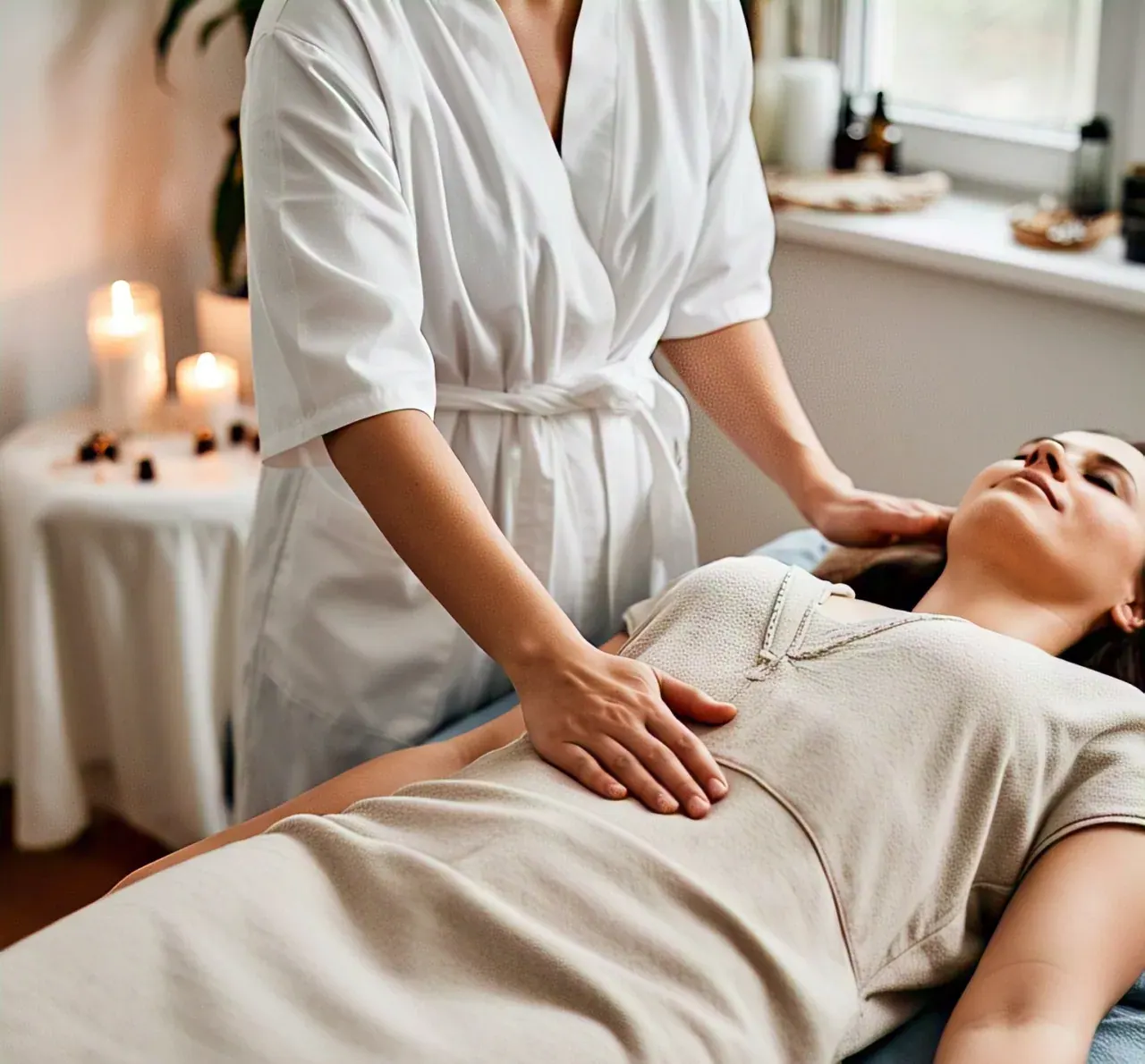
Self-Reiki is the practice of resting your own hands on a series of positions on your body while you sit or lie quietly. It is traditionally the first thing a Reiki student learns.
Reiki is a Japanese practice, and the word is usually explained as 'universal life energy'. Indian readers may find it close to the idea of प्राण (prana, life energy). There is no massage, no pressure and no equipment. The hands simply rest, and you breathe.
02
Who can practise self-Reiki?
Traditionally, self-Reiki is practised by someone who has received a Level 1 attunement from a Reiki teacher. Level 1 is the stage that covers working on yourself.
It is honest to say what that means for everyone else. Anyone can do the resting-hands routine below as a relaxation practice. Sitting still, placing warm hands on your body and breathing slowly needs no training. In the Reiki tradition, though, it is called self-Reiki only after attunement.
So if you are not attuned, think of this as a calming routine borrowed from Reiki. If you are, it is your daily practice.
03
What is a simple 10–15 minute hand-position sequence?
A simple sequence uses seven positions from the head down to the lower abdomen, held for about two minutes each. Sit or lie comfortably, keep your fingers together and let your hands rest lightly.
Breathe normally. If a position is awkward for your shoulders, hold your hands just above the area or skip it.
01
1. Eyes
Palms cupped gently over closed eyes, fingers resting on the forehead.
02
2. Temples
One palm on each side of the head, above the ears.
03
3. Back of the head
Both hands cradling the base of the skull.
04
4. Throat
Hands resting lightly on the collarbones. Do not press on the neck.
05
5. Heart
Both hands flat on the centre of the chest.
06
6. Upper abdomen
Hands just below the ribs, over the stomach area.
07
7. Lower abdomen
Hands below the navel. Rest here a little longer before you get up.
04
When should you do self-Reiki?
Do it at the same time each day, because a regular slot matters more than the hour you choose. Morning and bedtime are the two that most people manage to keep.
In the morning, try it before you pick up your phone. At night, do it lying in bed with the lights off. On a crowded day, even two positions for five minutes will keep the habit going.
Choose a time when you will not be disturbed. Never practise while driving or doing anything that needs your attention.
05
What do people commonly report?
Many people report warmth in the hands, slower breathing and a pleasant heaviness in the body. Falling asleep halfway through is very common, especially at night.
Some people notice tingling, a rumbling stomach or a few tears. Others notice nothing at all, and that is normal too. Nothing has gone wrong if a session feels ordinary.
These are personal experiences of relaxation. They are not signs that an illness is changing, and they should not be read that way.
06
What are the limits of self-Reiki?
Self-Reiki complements medical and mental-health care and never replaces it. It supports relaxation. It is not a treatment for any illness, injury or mental-health condition.
Please keep taking anything your doctor has prescribed, keep your appointments, and see a doctor about any new or lasting symptom. No Reiki practitioner should ask you to reduce or stop a medicine.
The same holds for emotional distress. If you are struggling, please reach out to a mental-health professional. In India you can call the free government helpline Tele-MANAS on 14416, available 24×7.
07
When to book a Reiki session
Book a session when you would like to be guided, when you want to ask about learning Reiki properly, or when resting is hard to do on your own.
Dr. Kimaya Parikh-Ambekar offers Reiki at VastuKimaya in Andheri East, Mumbai, alongside Vastu and other healing therapies. You can ask how a session works before you book an appointment. A home routine and a session with a practitioner sit well together.
Questions
Frequently asked
Can I do self-Reiki without attunement?
Traditionally, self-Reiki is practised after a Level 1 attunement from a Reiki teacher. Without attunement you can still use the same hand positions as a quiet relaxation routine. It is more honest to call that a resting-hands practice than Reiki, but sitting still and breathing slowly is open to everyone.
How long should a self-Reiki session be?
Ten to fifteen minutes is enough for a daily routine. That allows about two minutes on each of seven hand positions. On a busy day, five minutes on two or three positions is still worthwhile. A short session done regularly is more useful than a long one done once a month.
Can I do self-Reiki lying in bed?
Yes. Lying in bed is one of the easiest ways to practise, and many people use the routine to wind down at night. If you fall asleep before you finish, nothing is lost. Put a pillow under your knees if your lower back feels strained while lying flat.
Is it normal to feel nothing during self-Reiki?
Yes, it is completely normal. Some people feel warmth, tingling or heaviness, and others feel nothing unusual at all. A quiet, ordinary session is still ten minutes of rest. Try not to chase a sensation, because expecting one usually makes it harder to relax.
Can self-Reiki replace my medicine or therapy?
No. Self-Reiki is a complementary relaxation practice and never replaces medical or mental-health care. Continue with any medicine or therapy you have been prescribed, and speak to your doctor before changing anything. If you are in emotional distress, call Tele-MANAS on 14416, a free government helpline in India.
Can I do self-Reiki every day?
Yes. A short daily routine is the traditional way to practise, and many people find that a fixed time, such as early morning or bedtime, makes it easier to keep up. If you miss a day, simply begin again the next day without any guilt.
Want this applied to your own home or office?
Book free consultation