





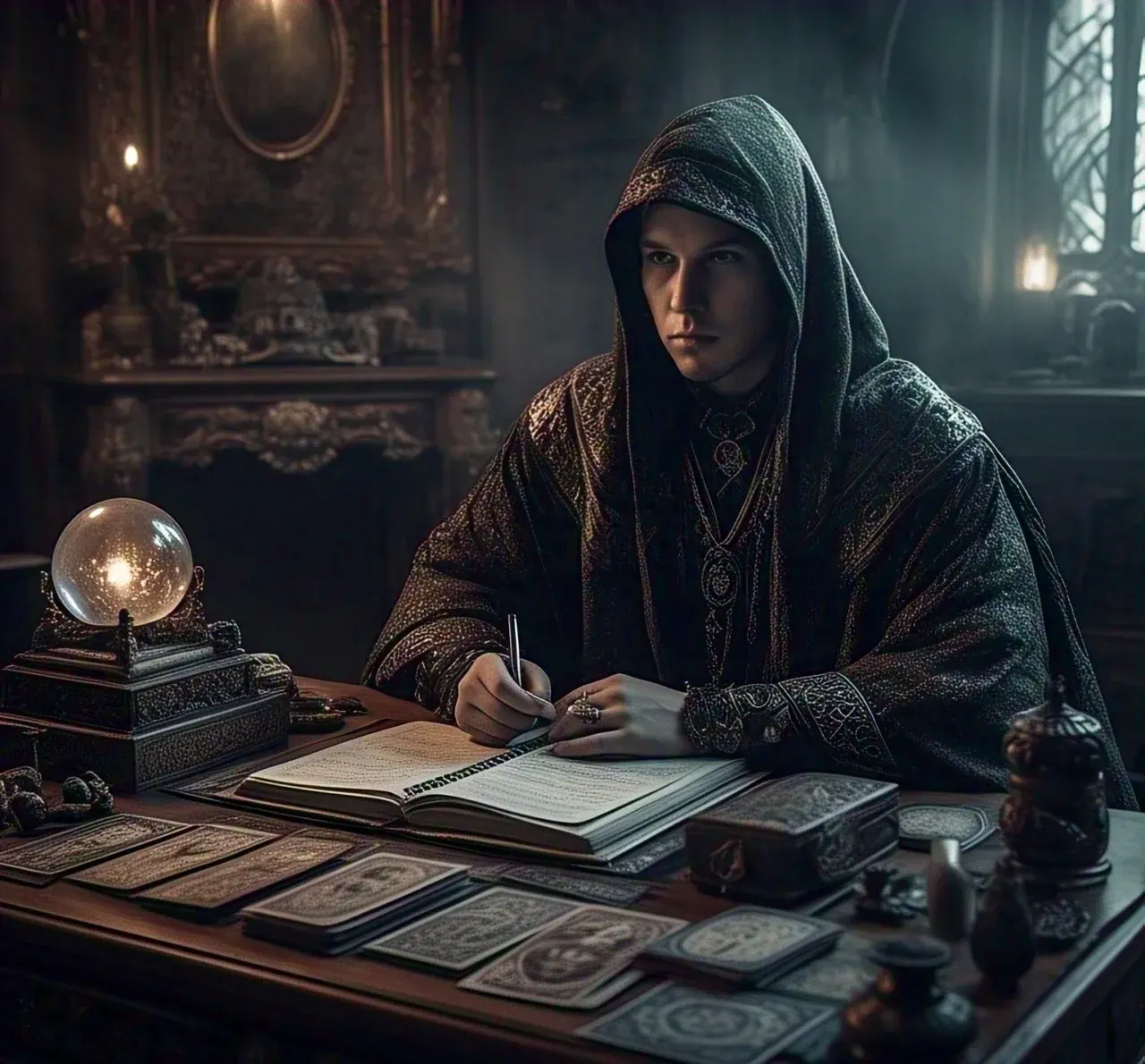
Tarot · 21 September 2026 · 7 min read
Tarot Myths and Facts: What Tarot Cannot Do
Death cards, cursed decks, gifted readers and predictions of the future — the most persistent tarot myths, and what is actually true about how the cards are used.
By Dr. Kimaya Parikh-Ambekar, Vastu consultant, Andheri East, Mumbai
Read this in: हिन्दी
01
Which tarot myths cause the most confusion?
The tarot myths that cause the most trouble are the ones that promise too much or frighten too easily: that cards reveal the future, that certain cards are omens of disaster, and that a reader possesses powers ordinary people do not.
Each of these makes a reading less useful, not more. If you believe the future is already written in the cards, there is nothing for you to do with the information. If you believe a card can doom you, you will spend the session braced rather than thinking. And if you believe the reader has powers, you will accept interpretations that do not fit your life.
Clearing away these ideas is not scepticism about tarot. It is what makes tarot work. The Sanskrit word भ्रम (bhram, illusion or mistaken belief) fits well here — removing the illusion leaves something smaller but genuinely usable.
02
Myth: tarot predicts the future
Tarot does not predict the future, and nothing else does either. This is the central myth and the one everything else rests on.
What a reading can describe is the present: your situation, your feelings about it, the options in front of you and the direction your current approach is heading. That last point is often mistaken for prophecy. Saying 'if you carry on avoiding this, here is where it leads' is an observation about a trajectory, and it stays true only until you change something.
Be particularly careful with anyone who offers dates, or who tells you an outcome is fixed. A reading should expand what you feel able to do, not narrow it.
03
Myth: the Death card means someone will die
The Death card does not indicate physical death, and no responsible reader interprets it that way. It reads as an ending and a transformation — a role you have outgrown, a phase closing, something finished in fact if not in name.
The same applies to the other cards people dread. The Tower describes a structure built on unstable ground coming down, which is unsettling in the moment and frequently a relief later. The Devil describes attachment and habit, and its imagery shows chains loose enough to lift off. The Three of Swords names heartbreak that already exists; it does not cause it.
Reversals attract the same unnecessary fear, and deserve the same correction. Dr. Kimaya does read reversed cards, but a reversal softens a card's theme or turns it inward — a delay, a hesitation, something known but not yet said. It is neither a punishment nor an omen.
There is a practical warning attached to this myth. If any reader shows you a frightening card and then offers, for a fee, to remove the danger, treat that as a reason to leave. Fear followed by a paid remedy is a sales technique, not a reading.
04
Myth: a tarot deck must be gifted, and other deck superstitions
You can buy your own deck. The idea that a deck must be a gift is folklore, widely repeated and entirely optional, and choosing your own artwork is a genuine advantage when you are learning.
01
Others touching your deck
No harm comes of it. Many readers have the client shuffle. Wipe the cards if you like — that is hygiene, not ritual.
02
Wrapping in silk, storing in wood
Pleasant habits that protect the cards physically. Nothing goes wrong if you use a cardboard box.
03
A dropped or damaged card
Means the card was dropped. Some readers glance at a jumped card out of interest; nothing is owed to it.
04
Cursed or unlucky decks
A deck is printed card stock. If one makes you uneasy, simply use another.
05
Only one deck ever
You may own several. Many readers use different decks for different kinds of questions.
05
Myth: you need a psychic gift to read tarot
Tarot can be learned. Reading well takes familiarity with the images, a clear method and the ability to ask good questions and listen — skills, not powers.
Experienced readers are often perceptive, but the perceptiveness comes from years of attention to how people talk about their lives, not from a channel to elsewhere. A reader who claims supernatural authority is claiming something they cannot demonstrate, and that claim is usually what makes a session feel oppressive rather than helpful.
This also means you can read for yourself. Draw a card each morning, write what you see, check at night. Within a couple of months you will be reading sensibly — and you will spot an overreaching reader immediately.
06
Myth: tarot is against religion, or dangerous to use
Tarot is a deck of illustrated cards used for structured reflection. It asks nothing of your faith, requires no ritual and involves no invocation of anything.
People of many religious backgrounds use the cards simply as a way to think, and those who prefer not to use them lose nothing. If tarot sits uncomfortably with your beliefs, that is a perfectly good reason not to use it — and there are other reflective practices that may suit you better.
The real caution is not spiritual but practical: do not let a reading substitute for expertise or for care. Cards cannot diagnose illness — see a doctor. They cannot advise on a dispute — see a lawyer. They cannot assess an investment — see a qualified financial adviser. And if a reading stirs up distress that does not settle, please speak to a mental-health professional. In India you can call the free Tele-MANAS helpline on 14416 (or 1-800-891-4416), available 24×7.
07
What is actually true about tarot?
What is true is modest and genuinely useful: tarot gives you a structured, image-led way to examine one question, and images are unusually good at pulling out thoughts that direct questioning misses.
A good session leaves you with a clearer account of your situation and two or three things you could do about it. It leaves your agency intact. It does not leave you dependent on the reader, frightened of a card, or waiting for a predicted event.
The deck itself is ordinary too: Dr. Kimaya reads the Rider–Waite–Smith 78-card deck, the same one sold in any good bookshop. Judged by that standard, tarot sits comfortably alongside other reflective practices — much as Vastu works with the arrangement of a space. None of them is a substitute for professional advice, and none of them promises outcomes.
08
When to book a tarot reading
Book a reading when you want an honest conversation about a real question — and choose a reader who explains rather than pronounces, who declines medical and legal questions, and who never uses fear.
Dr. Kimaya Parikh-Ambekar offers tarot readings online by video call from VastuKimaya in Andheri East, Mumbai, alongside Vastu consultancy, Reiki and crystal therapy. Readings are for adults aged 18 and over. You are welcome to ask how a reading works before you book; a reader who cannot answer that plainly is worth avoiding.
Questions
Frequently asked
Do tarot cards really predict the future?
No. They describe your present situation and the direction your current approach is heading. Any reading claiming to know future events or dates is overstating what tarot can do.
Is the Death card in tarot bad?
No. It reads as an ending and transformation — a phase or role finishing so something else can begin. It has no bearing on physical death.
Can I buy my own tarot deck?
Yes. The belief that a deck must be gifted is folklore. Choosing artwork you connect with makes learning considerably easier.
Can other people touch my tarot cards?
Yes. Many readers ask clients to shuffle. Nothing is damaged by handling, though you may prefer to keep the deck clean and protected.
Do you need to be psychic to read tarot?
No. Reading is a learnable skill built on knowing the images, using a clear method, and asking good questions while listening carefully.
Can tarot tell me about my health?
No. Cards cannot diagnose or assess anything medical. For any symptom or health concern, a doctor is the right person to consult.
Want this applied to your own home or office?
Book free consultation