






Vastu Shastra · 19 September 2026 · 5 min read
The Eight Directions and Their Deities in Vastu
Kubera in the North, Agni in the South-East, Varuna in the West: meet the eight guardian deities of Vastu directions and what each means for your home.
By Dr. Kimaya Parikh-Ambekar, Vastu consultant, Andheri East, Mumbai

01
Why does Vastu link directions with deities?
Vastu links directions with deities because each direction is understood to carry a distinct quality of energy, and the deity personifies that quality. These guardians are traditionally called the दिक्पाल (Dikpala, guardians of the directions).
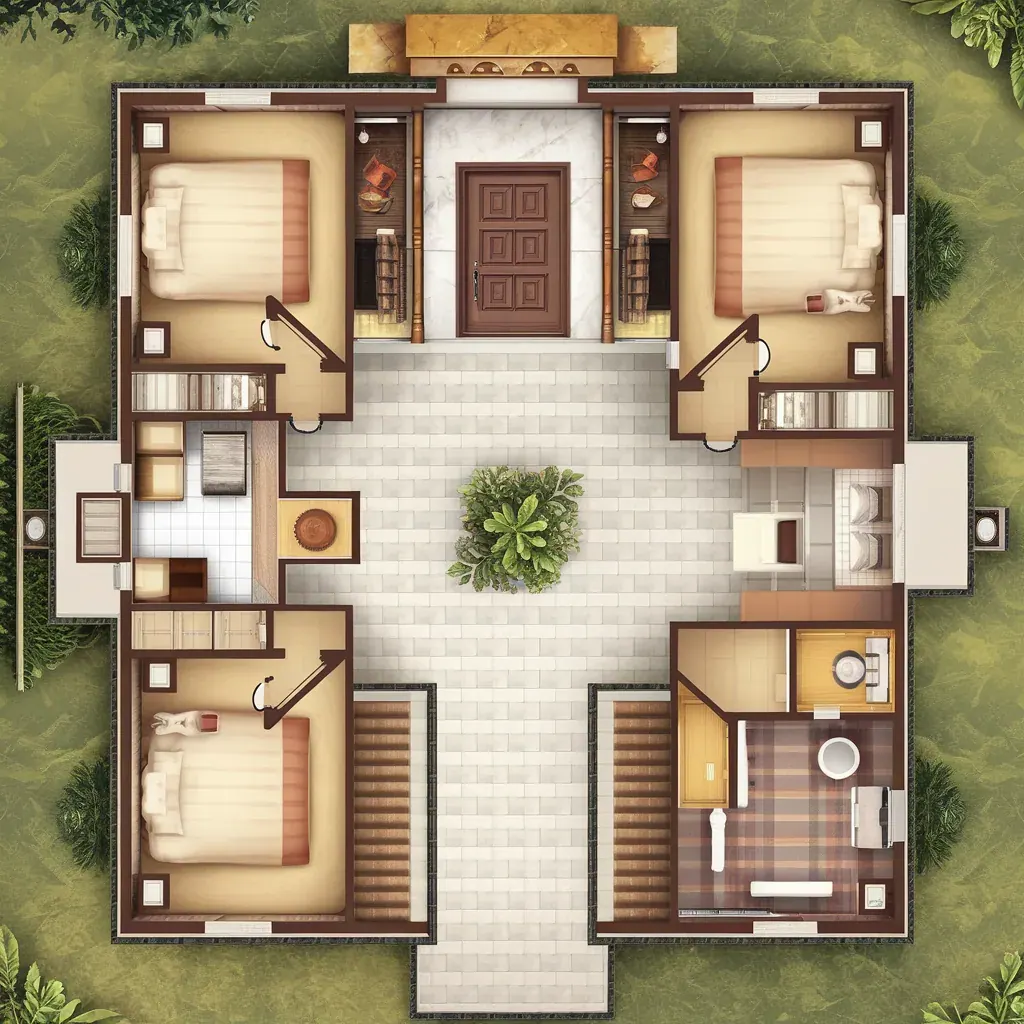
The directions are laid out on the वास्तु पुरुष मंडल (Vastu Purusha Mandala), the sacred grid that maps a plot or home. At its centre is the ब्रह्मस्थान (Brahmasthan), associated with Brahma and the space element. Understanding the deities helps you remember why a kitchen, bedroom or pooja room belongs where it does, instead of memorising rules.
The idea of directional guardians appears widely in Indian temple architecture, where the Dikpalas are often carved at the corners and sides of temples. Vastu brings the same understanding into everyday homes and workplaces, so that daily life is aligned with the qualities each direction is believed to hold.
02
Who rules the North in Vastu?
The North is ruled by Kubera, the guardian of wealth and treasures. This direction is associated with money flow, career opportunities and new openings.
Keep the North light, open and uncluttered. It suits the living room, a study, balconies and windows, and cash lockers are placed so that they open towards the North. Heavy storage and toilets in the North are generally avoided.
03
Why is the North-East called Ishanya?
The North-East is called ईशान्य (Ishanya) because it is ruled by Isha, a form of Shiva, and is considered the most sacred corner of the home. It carries the water element and is linked with clarity, wisdom and spiritual growth.
The North-East is ideal for the pooja room or mandir, meditation, and open, light spaces. It should be kept clean, low and free of heavy furniture, toilets and kitchens.
04
What do the East and South-East represent?
The East represents light, health and growth, and is ruled by Indra, king of the devas, with Surya, the sun, closely associated. The South-East is ruled by Agni, the fire deity, and carries the fire element.
01
East, Indra and Surya
Ideal for windows, the main entrance, living spaces and a study. Morning sunlight here is considered highly beneficial.
02
South-East, Agni
The traditional zone for the kitchen, with the cook facing East, and for electrical equipment such as inverters and meters.
05
Is the South, ruled by Yama, a bad direction?
No, the South is not a bad direction. It is ruled by Yama, who in Vastu represents dharma, discipline and order, not only endings. The South carries a strong, grounding energy that supports rest, fame and steady effort.
The South suits bedrooms, heavy storage and solid walls. South-facing homes and offices are common and perfectly workable; the exact entrance pada matters more than the direction alone, and remedies are available where needed.
06
What does Nairutya in the South-West govern?
Nairutya governs the South-West, the zone of the earth element, and is associated with stability, strength, relationships and control. It is the heaviest and most grounding corner of the home.
The South-West is ideal for the master bedroom, the owner's cabin in an office and heavy cupboards or lockers. It should not be cut, left open or used for a main entrance or toilet where avoidable.
07
What do Varuna in the West and Vayu in the North-West represent?
Varuna, the deity of water and cosmic order, rules the West, and Vayu, the wind deity, rules the North-West. The West is linked with gains and the fruits of effort, while the North-West carries the air element and governs movement, support and communication.
01
West, Varuna
Suits the dining room, children's rooms, a study and overhead water storage.
02
North-West, Vayu
Suits guest rooms, children's rooms, storage of finished goods, and an alternative kitchen position.
08
How can you use this knowledge in your home?
Use this knowledge by matching each room's purpose to the quality of its direction, and by keeping each zone in a condition that honours its deity. A clean North for Kubera, a sacred North-East for Isha and a solid South-West for Nairutya are good starting points.
Most homes, especially flats, do not match every ideal. That is normal. Every direction has strengths, and where a room sits in a less suitable zone, non-structural remedies such as colour, metal, crystals, pyramids or Reiki can restore balance without demolition.
A simple exercise is to stand at the centre of your home with a compass and slowly turn to face each direction, noting which room lies there. Ask whether the room's use and condition match the quality of that direction's deity. This walk-through often reveals quick, practical changes, such as clearing clutter from the North or moving a heavy cupboard out of the North-East.
09
When to consult a Vastu expert
Consult a Vastu expert when you want an accurate map of the directions in your own home, because a compass reading from the true centre often differs from what a brochure plan suggests.
Dr. Kimaya Parikh-Ambekar maps homes and offices zone by zone from VastuKimaya's office in Andheri East, on-site across Mumbai and by distant consultation using floor plans. You receive a personalised report with practical remedies.
Questions
Frequently asked
Which deity rules the North-East in Vastu?
Isha, a form of Shiva, rules the North-East, which is why it is called Ishanya and is considered ideal for the pooja room.
Who is the deity of the South-East direction?
Agni, the fire deity, rules the South-East, making it the traditional zone for the kitchen.
Which direction belongs to Kubera?
The North belongs to Kubera, the guardian of wealth, so it is kept clean and cash lockers open towards it.
Who rules the centre of the home in Vastu?
The centre, called the Brahmasthan, is associated with Brahma and the space element, and is kept open and light.
Is a West-facing house good as per Vastu?
Yes, a West-facing house can be good. The West is ruled by Varuna and linked with gains; the exact entrance position determines whether any remedy is needed.
Want this applied to your own home or office?
Book free consultation